
Featured Article: The Regenerative 7Cs|Core: Aligning What You Say with What You Do
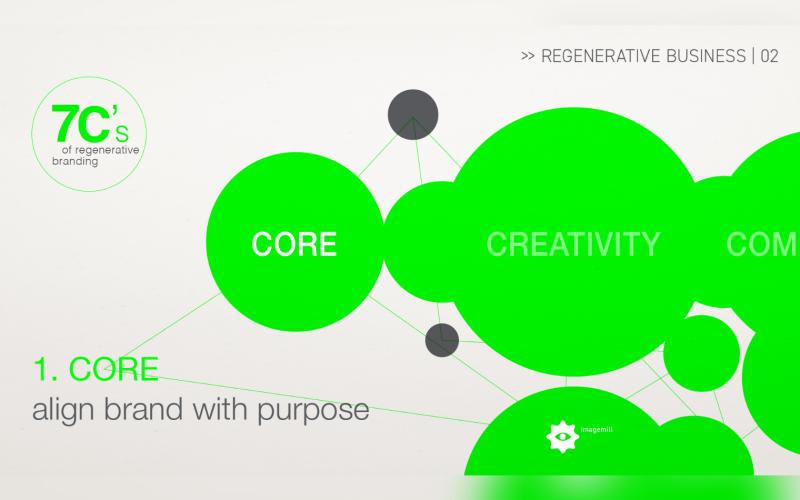
After introducing the Regenerative 7Cs last month, we begin the deeper dive with the most fundamental principle: CORE.
If regeneration is a journey, the core is where everything begins. It is the difference between a company that talks about sustainability and a company that actually operates regeneratively. Without alignment between purpose and practice, every other effort (creativity, circularity, communication) rests on weak ground.
And in today’s world, misalignment is not just a cultural issue. It is a business risk. Employees test it, customers sense it, and stakeholders increasingly demand it.
________________________________________
Why CORE Matters: Purpose Must Become Practice
A regenerative company makes sure its values shape daily decisions in sourcing, HR, governance, product design, leadership behaviour and partnerships. Put simply, regeneration has to be lived internally before it can be expressed externally.
Japan and Ireland both have long-standing business traditions that understood this long before the idea of “ESG” existed.
● Sanpo Yoshi, the traditional merchant philosophy, insisted that business must be good for the seller, the buyer and society.
● Irish cooperatives and family enterprises built trust by ensuring that community benefit was part of how the business operated, not an afterthought in marketing.
Modern regeneration simply updates these principles for the pressures and transparency of the present day.
________________________________________
The Alignment Gap
Many companies publish sustainability goals. Far fewer integrate them into day-to-day decision making. This creates the familiar “say–do gap,” a disconnect between external commitments and internal behaviour.
Regeneration cannot gain traction if that gap is wide.
Compare two approaches:
● Superficial sustainability might rely on a recycled materials pilot or a seasonal brand campaign.
● A regenerative core means values are visible in procurement standards, leadership incentives, workplace culture and long-term strategy.
One is cosmetic. The other is structural.
________________________________________
Examples of CORE in Practice
In Japan:
● MUJI’s sourcing philosophy influences design, supply chain decisions and store experience.
● Toyota’s practices such as Genchi Genbutsu (go and see) and Kaizen embed continuous improvement into environmental and social performance, not just product quality.
In Ireland:
● The Handmade Soap Company demonstrates what it looks like when values guide every part of a business. Ethical sourcing, plant-based ingredients, recyclable packaging and transparent production are not marketing claims but operating principles. Their internal culture is built around fairness, worker wellbeing and low-impact design, and that alignment is evident in everything from product development to long-term planning.
● Ireland’s cooperative heritage offers another model. These businesses link economic activity directly to community resilience, ensuring purpose and practice reinforce one another.
These organisations do not pretend to be perfect, but their strength lies in consistency between their values and their behaviour.
________________________________________
How to Strengthen Your Core
Three diagnostic questions
1. Do our operations reflect our stated values?
2. Would employees, suppliers and customers describe our company in the same way we do?
3. If every sustainability claim disappeared from our website tomorrow, would our actions still demonstrate our purpose?
Three starting actions
● Carry out a core audit and map where values are, and are not, embedded.
● Create a short purpose playbook that translates mission statements into practical guidance for teams.
● Set up accountability loops so that KPIs, performance reviews and leadership incentives support regenerative goals.
Early indicators of progress
● Percentage of suppliers meeting ethical or environmental criteria
● Percentage of leadership incentives tied to regenerative targets
● Internal trust, engagement and retention measures
________________________________________
Closing Reflection
Regeneration is not a communications challenge. It is a coherence challenge. The companies that thrive in the coming decade will be those whose purpose is evident not in their statements, but in how they work every day.
Next month, we explore the second C: Creativity — how imagination and design spark real transformation.
________________________________________
Byline
Written by Rick Grehan, IJCC Board Member and Sustainability Committee Manager, and founder of imageMILL.