
Featured Article: The Regenerative 7Cs | Creativity: Designing for Transformation
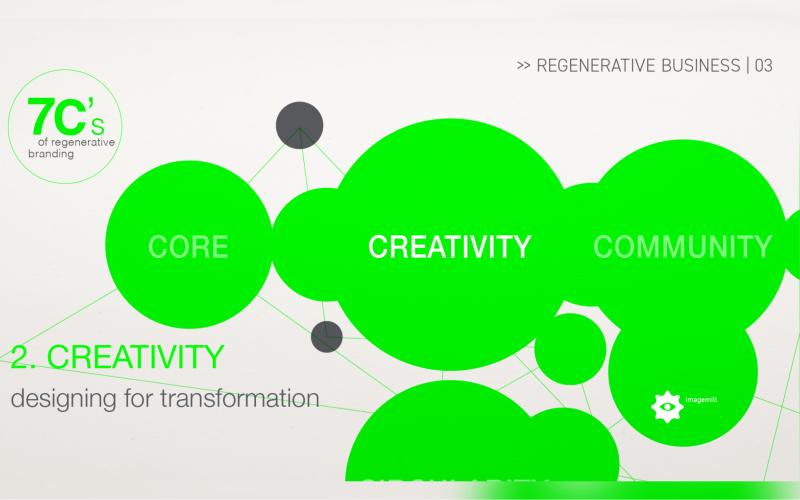
In the last article, we explored CORE and why regeneration must begin with alignment between values and daily decisions. Once that foundation is in place, the next question becomes practical: how do we turn purpose into real products, services, and systems?
This is where CREATIVITY comes in.
In regenerative business, creativity is not decoration and it is not limited to marketing. It is a strategic capability. Creativity is how values become tangible, how ideas become offerings, and how regeneration becomes commercially viable
________________________________________
Creativity Beyond Campaigns
Many organisations still treat creativity as something applied at the end of a process. A campaign to explain a strategy. A design layer added once decisions are already made.
Regenerative companies use creativity much earlier. They apply it at the point of problem definition, system design, and innovation. Creativity becomes a way to rethink how things work, not just how they look.
This shift matters because regeneration requires new answers to old questions about efficiency, resilience, and growth
________________________________________
Learning from Nature: Biomimicry in Business
Nature has been solving complex design problems for billions of years. It operates without waste, builds resilience through diversity, and creates closed-loop systems where outputs become inputs.
Biomimicry brings this intelligence into business thinking by asking a simple but powerful question: how would nature solve this problem?
In practice, this can mean:
- Designing packaging inspired by fruit skins or shells
- Creating cooling systems based on termite mounds
- Rethinking organisations as ecosystems rather than rigid hierarchies.
This is not about copying nature literally. It is about learning from its principles and applying them creatively to human systems.
________________________________________
Design Thinking Meets Circularity
Design thinking already encourages empathy, iteration, and prototyping. Biomimicry deepens it by adding a systems perspective.
Together, they help companies:
- Design products for reuse, repair, and adaptability
- Reduce materials and energy at the source
- Build circular systems from the start rather than retrofitting them later
This is how creativity becomes the bridge between CORE alignment and CIRCULARITY in action.
________________________________________
A Cultural Fit for Japan and Ireland
This approach is not foreign to either Japan or Ireland.
In Japan, Monozukuri reflects respect for materials and process, while Kaizen mirrors natural systems through continuous adaptation. Nemawashi supports creative problem-solving through early consensus.
In Ireland, design-led small businesses have long used constraint as a source of innovation. Craft traditions, repair culture, and storytelling all show how creativity can carry values while remaining commercially grounded.
________________________________________
Putting CREATIVITY into Practice
Three questions to ask
- Are we using creativity only to communicate, or also to design systems?
- Are creative teams involved early enough to influence decisions?
- Have we asked how nature might solve our biggest inefficiencies?
Three first actions
- Run a biomimicry-inspired design sprint on one real business challenge
- Map your product or service against natural flows like energy, water, or nutrients
- Prototype one small change that reduces waste while improving customer experience
________________________________________
Closing Reflection
Regenerative creativity does not ask businesses to lower standards or sacrifice performance. It asks them to design more intelligently.
When companies learn from nature and apply creativity upstream, regeneration stops feeling like constraint and starts becoming a source of innovation and advantage.
Next month, we explore the third C: Community & Connection, and what it means to build business with people and place.
________________________________________
Byline
Written by Rick Grehan, IJCC Board Member and Sustainability Committee Manager, and founder of imageMILL.